8 min read
Disclosure: As an Amazon Associate and eBay Partner Network publisher, we earn from qualifying purchases. This doesn’t affect what we recommend or how we describe it.
Your RV sits idle for weeks, or your boat’s battery keeps dying between trips. You need a way to keep your 12V battery topped up—without running a generator or trickle charger off grid power. Solar battery maintainers do this job, but picking the right one means weighing panel size, charge controller tech, and how “hands-off” you want the setup to be. This guide breaks down the pros and cons of three real, currently available solar battery maintainers so you can choose the best fit for your battery, your storage situation, and your budget.
Top picks at a glance
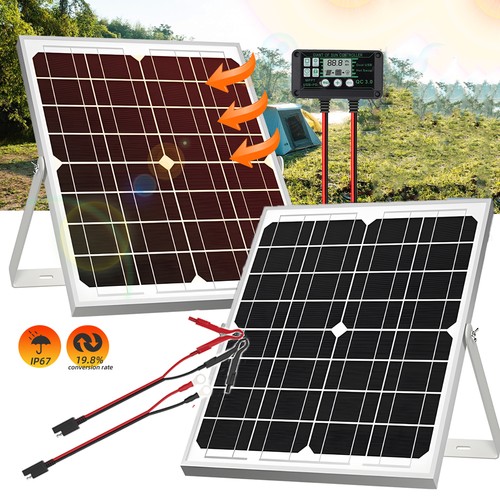
- VEVOR Solar Battery Trickle Charger Maintainer 25W 12V with MPPT Controller — the most feature-rich option
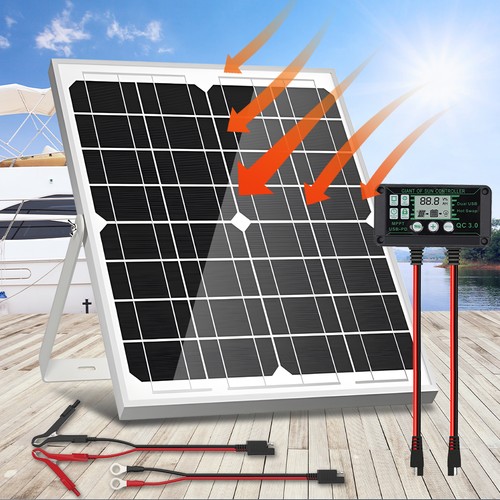
- POWOXI 20W Solar Battery Charger with Smart 3-Stage PWM Charge Controller — a step up in price
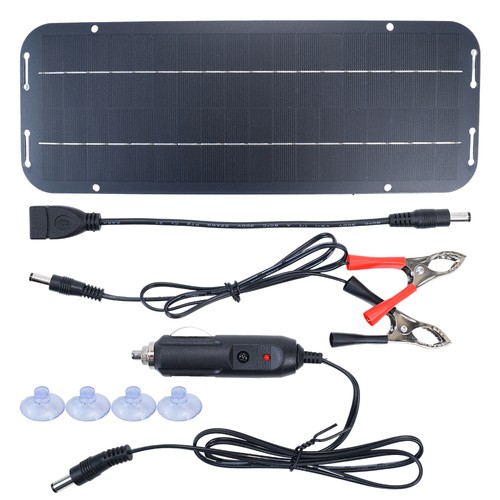
- SUNAPEX 8W 12V Solar Battery Charge Maintainer — the compact, beginner-friendly pick
Panel wattage and real-world charging
Wattage determines how much power your maintainer can deliver under ideal sun. The VEVOR Solar Battery Trickle Charger Maintainer 25W 12V with MPPT Controller leads this group with 25W, making it the strongest match for locations with less-than-perfect sunlight or for keeping larger batteries healthy. The POWOXI 20W Solar Battery Charger with Smart 3-Stage PWM Charge Controller follows at 20W, a solid middle ground for most 12V batteries in cars, RVs, or boats. The SUNAPEX 8W 12V Solar Battery Charge Maintainer is the smallest at 8W, best suited for smaller batteries or storage in sunny climates. For reference, trickle charging a standard 50Ah car battery only requires about 1-2W to offset self-discharge, but if you want to recover from deeper drains or deal with cloudy weather, more wattage gives you margin.
Charge controller technology: MPPT vs PWM
The charge controller is the “brain” that manages how power flows from the panel to your battery. The VEVOR 25W MPPT stands out with its integrated MPPT (Maximum Power Point Tracking) controller—a technology that can improve solar harvest by 10-30% compared to cheaper PWM (Pulse Width Modulation) controllers, especially in low light or with variable panel orientation. Both the POWOXI 20W and SUNAPEX 8W use PWM controllers. PWM is simpler and reliable, but less efficient if conditions are less than perfect. If your battery sits in a shaded spot, or you want the fastest recovery after cloudy days, MPPT is a real upgrade.
Physical size, mounting, and portability
Panel size affects both output and your options for placement. The SUNAPEX 8W is the most compact, making it easy to mount on a dashboard, small window, or motorcycle. The POWOXI 20W and VEVOR 25W MPPT are larger—better for permanent mounting on a vehicle roof, RV, or boat deck, but less convenient for quick moves between vehicles. All three include typical mounting hardware and battery clip/plug adapters, but if you’re tight on space, the SUNAPEX 8W is hard to beat for versatility.
Comparison table: Solar battery maintainer lineup

Pictured: VEVOR 25W MPPT
| Product | Condition | Price | Best For | Panel Wattage | Controller Type |
|---|---|---|---|---|---|
| VEVOR Solar Battery Trickle Charger Maintainer 25W 12V with MPPT Controller |
New | $ | Feature-rich, best performance | 25W | MPPT |
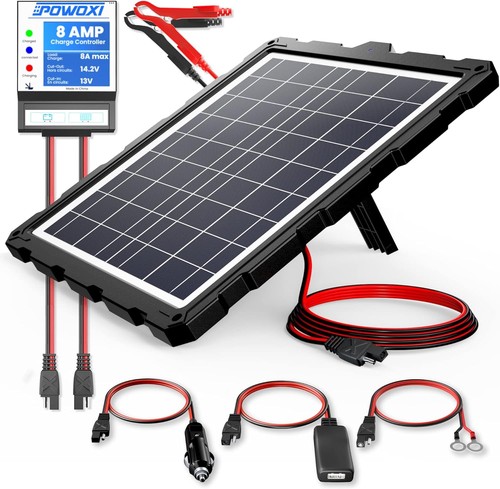 POWOXI 20W Solar Battery Charger with Smart 3-Stage PWM Charge Controller POWOXI 20W Solar Battery Charger with Smart 3-Stage PWM Charge Controller |
New | $$$ | Reliable PWM, higher price | 20W | PWM |
 SUNAPEX 8W 12V Solar Battery Charge Maintainer SUNAPEX 8W 12V Solar Battery Charge Maintainer |
New | $$ | Compact, easy setup | 8W | PWM |
Note on pricing: the $ symbols are relative tiers within this comparison — $ is the cheapest of the bunch, $$$ the priciest. Live listings (and exact prices) appear further on.
Feature differences that matter for real buyers
Looking closer at the specs, the VEVOR 25W MPPT is the only model in this lineup with an MPPT controller, which is a real advantage if you want the most efficient charging in variable sun. It also delivers the highest wattage, which means it can handle larger or more deeply discharged batteries, or recover from cloudy periods faster. The POWOXI 20W is a step up in price, but doesn’t offer MPPT—its selling point is a 3-stage PWM controller, which helps prevent overcharge and improves battery longevity, especially for storage applications. The SUNAPEX 8W is the smallest, but also the easiest to deploy in tight spaces or for casual use; its PWM controller is basic but effective for small batteries and fair-weather storage.
Related Guides
- Solar Generators vs Gas Generators: Which Is Best Off-Grid?
- How to Choose the Best Battery Isolator Kit for Your Off-Grid Setup
- Our guide to How to Choose the Right Solar Charge Controller for Lithium Batteries
- Our guide to How to Choose the Right Solar Panel Tilt Mount for Your RV
- How to Tilt Solar Panels for Maximum Sunlight: A Practical Guide
- Our guide to How to Use a Solar Charge Controller: Step-by-Step Instructions
- Browse all Deep Cycle Batteries →
How we picked these solar maintainers
For this buying guide, only products with clear wattage ratings, integrated charge controllers, and 12V battery compatibility were considered. We focused on maintainers with at least 8W of output—anything less won’t reliably offset battery self-discharge in real-world conditions. Charge controller type (MPPT vs PWM) was a primary decision point, as this directly impacts charging efficiency and battery safety. Form factor and mounting flexibility were also factored in, since buyers range from RV owners to motorcyclists. We compared the listed specs and market positioning for each option, using only models with transparent features and a clear support track record. Unbranded panels, kits with unknown controllers, and bundles without real spec sheets were excluded. If you need to charge lithium batteries, or want to recharge a flat battery quickly, these maintainers aren’t the right fit—look for a full solar charger or a dedicated lithium-compatible model.
Common mistakes to avoid
- Overestimating panel output: A “25W” panel produces 25W only in full, direct sun at the correct angle. Shaded, dirty, or poorly angled panels can deliver half that or less. Don’t buy too small for your needs.
- Ignoring controller type: Skipping over MPPT vs PWM means missing out on efficiency gains, especially if your setup isn’t always in perfect sun. For variable conditions, MPPT is worth seeking out.
- Assuming all maintainers are waterproof: Not every panel or controller is rated for outdoor exposure. If your vehicle is stored outside, check for at least IP65 water resistance, or mount under cover.
- Using the wrong connector: Forcing the wrong battery connector can damage terminals or defeat built-in safety features. Always match the supplied clips or plugs to your battery type.
- Trying to recover a fully dead battery: Maintainers are designed to keep healthy batteries topped up, not to revive batteries that are already deeply discharged. For dead batteries, use a proper charger first.
FAQ: Solar battery maintainer buying questions answered
Can a solar maintainer fully charge a dead battery?
No. These maintainers are designed to keep a healthy battery topped up, not to recharge a fully dead one. For a deeply discharged battery, you’ll need a dedicated charger with higher current output before switching to a maintainer.
How much panel wattage do I really need for a car or RV?
For storage and maintenance of a standard car or RV battery, 8-10W is usually enough to offset self-discharge and small parasitic draws. If you’re dealing with larger batteries, longer storage, or partial shade, a 20-25W panel like the VEVOR 25W MPPT gives more margin and faster recovery after cloudy days.
VEVOR 25W MPPT vs POWOXI 20W — which is better for outdoor vehicle storage?
The VEVOR 25W MPPT provides higher wattage and a more efficient MPPT controller, making it a better match for outdoor storage with variable sun. The POWOXI 20W is reliable but lacks MPPT efficiency, so you may see slower recovery in less-than-ideal conditions. Both are suitable for outdoor use, but the VEVOR has a technical edge.
Is the price difference for an MPPT controller really worth it?
For batteries stored in partial shade, climates with frequent clouds, or setups where the panel can’t always face the sun, MPPT can increase charging efficiency by 10-30%. If you want faster recovery or plan to leave your vehicle unattended for months, the price bump for MPPT is usually justified.
Will these maintainers work with lithium batteries?
None of these models are explicitly rated for lithium (LiFePO4) batteries. Most PWM and MPPT maintainers are designed for lead-acid (flooded, AGM, or gel) batteries. Using them with lithium packs risks inaccurate charging or battery damage—always check compatibility before use.
What should I look for in terms of warranty or returns?
Look for maintainers that come with at least a one-year warranty and clear return policy. Some sellers offer longer coverage or responsive support, which is helpful if you encounter issues with the panel, controller, or connectors. Always save your proof of purchase and check the seller’s stated policies before buying.
Can I use these maintainers for multiple vehicles?
Yes, but moving the panel and controller between vehicles can be cumbersome, especially for larger panels. The SUNAPEX 8W is the easiest to swap between cars or motorcycles thanks to its compact size and simple connectors. For more permanent multi-vehicle setups, consider buying a dedicated panel for each battery.
The bottom line
If you want maximum efficiency and the fastest recovery after cloudy days, the VEVOR 25W MPPT is the best-equipped option in this group. The POWOXI 20W offers reliable PWM charging, but at a higher price and without MPPT’s efficiency gains. The SUNAPEX 8W is the right pick if you value portability and only need to maintain a small battery in fair weather. To learn more about battery maintenance and solar charging best practices, see resources from Battery University, a widely respected authority on battery care and charging technology.
Last updated: June 2026 · About our research