

9 min read
Disclosure: As an Amazon Associate and eBay Partner Network publisher, we earn from qualifying purchases. This doesn’t affect what we recommend or how we describe it.
12V water pumps for off-grid setups can deliver anywhere from 1.2 to 5.5 gallons per minute, but not every model is built for the same job. Whether you’re running a single faucet in a van conversion or need to supply a full RV shower, the difference between a compact 1.2 GPM pump and a heavy-duty 5.5 GPM unit is night and day. Picking the best 12V water pump means balancing flow rate, pressure, size, and power draw for your real-world needs—otherwise, you risk wasting money or ending up with a system that just can’t keep up.
Top picks at a glance
- VEVOR Water Pressure Pump 12V DC 1.2 GPM 2-Chamber Diaphragm Pump — the most compact choice
- VEVOR RV Water Pump 12V DC 5 GPM 4-Chamber Diaphragm Water Pump — the high-flow option
- VEVOR 12V Water Pressure Diaphragm Pump Self-Priming Pump 70 PSI 5.5 GPM — the heavy-duty pick
Spot the difference between the top 12V water pumps

Pictured: VEVOR 1.2 GPM
| Product | Condition | Price | Best For | Max Flow Rate (GPM) | Max Pressure (PSI) |
|---|---|---|---|---|---|
| VEVOR Water Pressure Pump 12V DC 1.2 GPM 2-Chamber Diaphragm Pump |
New | $ | Most compact choice | 1.2 | — |
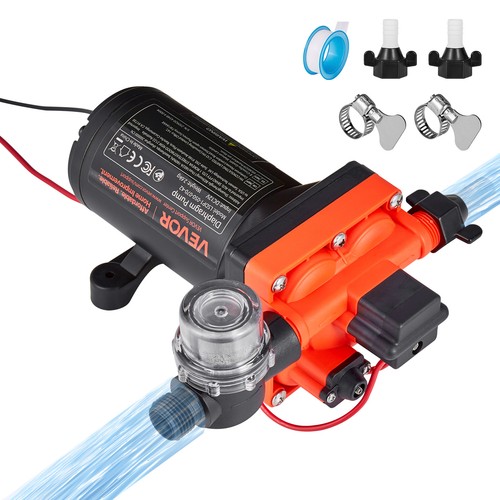 VEVOR RV Water Pump 12V DC 5 GPM 4-Chamber Diaphragm Water Pump VEVOR RV Water Pump 12V DC 5 GPM 4-Chamber Diaphragm Water Pump |
New | $$ | High-flow option | 5 | — |
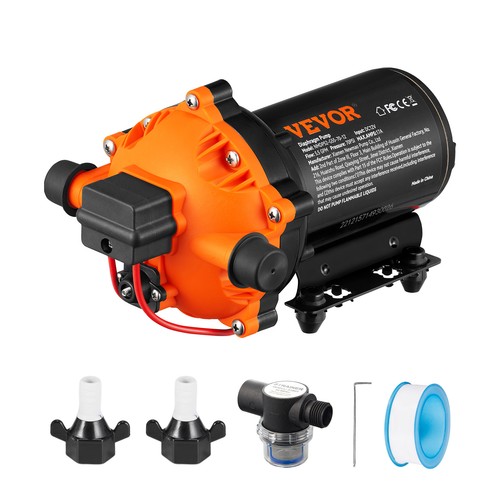 VEVOR 12V Water Pressure Diaphragm Pump Self-Priming Pump 70 PSI 5.5 GPM VEVOR 12V Water Pressure Diaphragm Pump Self-Priming Pump 70 PSI 5.5 GPM |
New | $$$ | Heavy-duty pick | 5.5 | 70 |
$ / $$ / $$$ indicates budget / mid-range / premium relative to the picks above. Check live listings further down for current prices.
Choose the right 12V water pump for your setup
Start by sizing your water pump to your real needs. For a solo van or tiny off-grid cabin, the VEVOR Water Pressure Pump 12V DC 1.2 GPM 2-Chamber Diaphragm Pump is the most compact and efficient. At just 1.2 GPM, it’s designed for low-demand applications: think a single sink, a hand-held outdoor shower, or occasional dishwashing. Small 2-chamber pumps like the VEVOR 1.2 GPM are easy to tuck under a bench or behind a cabinet, and their lower power draw is a plus if you’re running a tight battery budget.
Need real pressure for multiple fixtures or a full-size RV? The VEVOR RV Water Pump 12V DC 5 GPM 4-Chamber Diaphragm Water Pump steps up with 5 GPM of flow. This is a big jump: enough to run a shower and sink at the same time without a huge pressure drop. The 4-chamber design improves smoothness and reduces cycling, which means less pulsing in your water lines and quieter operation. This is the workhorse for most family RVs, off-grid cabins, or mobile food trucks that need to serve multiple taps.
For the heaviest demands—think multiple showers, high-pressure spray, or long pipe runs—the VEVOR 12V Water Pressure Diaphragm Pump Self-Priming Pump 70 PSI 5.5 GPM is the clear heavy-duty pick. It delivers up to 5.5 GPM at a listed max pressure of 70 PSI. That’s more than double the pressure of many entry-level RV pumps. If you’re pushing water uphill, running through long hoses, or want the closest thing to residential water pressure in your off-grid system, the VEVOR 5.5 GPM is built for it.
Match pump specs to your water system’s real demands
Flow rate (GPM) and pressure (PSI) are the two numbers that matter most for off-grid use. For context, a typical RV shower uses about 1.5–2.5 GPM, while a kitchen faucet is usually under 1.5 GPM. If you want to run two fixtures at once without a big drop in pressure, a pump rated for at least 4–5 GPM is a safer bet. The VEVOR 1.2 GPM is a fit for simple, single-point setups. The VEVOR 5 GPM and 5.5 GPM models are sized for multiple taps or heavier use.
Pressure matters for comfort and appliance function. Some water heaters and washing machines require at least 40 PSI to work properly. The VEVOR 5.5 GPM’s 70 PSI rating gives you plenty of headroom for longer pipe runs or going uphill. Lower-pressure pumps can struggle with long hose runs or higher elevation changes, so always check your layout before choosing the smallest pump that “might” work.
Consider installation space and noise
Size and noise level are often overlooked. The VEVOR 1.2 GPM is the most compact, making it ideal for builds where every inch counts. Smaller pumps are also generally quieter, which is a big plus in vans or tiny homes. The higher-flow VEVOR 5 GPM and VEVOR 5.5 GPM units will take up more space and may generate more vibration and noise—something to plan for in close quarters. Use rubber mounts or isolation pads to cut down on noise transmission if your pump will be near living or sleeping spaces.
Don’t ignore power draw on your 12V system
Larger pumps pull more current, especially under load. While specific amp ratings aren’t always listed, a 5.5 GPM pump at 70 PSI can easily draw 8–12 amps at peak—something to factor into your wiring and battery sizing. For solar-powered or battery-only setups, always check your system’s available current and fuse ratings before committing to a high-flow pump. Oversizing your pump “just in case” can mean wasted energy or even tripped breakers.
Related Guides
- Our guide to Understanding Solar Panel Mismatch Losses and How to Prevent Them
- Our guide to Inline Fuse vs Circuit Breaker: Which Is Better for Off-Grid Power?
- 12V LED Interior Lights With Switches: The Best Options for Your RV
- Air-Cooled vs Liquid-Cooled Generators: What’s the Real Difference?
- Solar Powered Fans That Are Actually Worth Buying
- Our guide to MPPT vs PWM Charge Controllers: What’s the Real Difference?
- Browse all 12V Appliances →
Red flags in listings to walk past
- No stated GPM or PSI: If a listing doesn’t clearly say how much water it moves or at what pressure, walk away. These numbers are non-negotiable for sizing a pump to your needs.
- Stock photos with no real product shots: Listings that only use generic images may be hiding a different or lower-quality product. Real pumps should have photos showing the actual unit, ports, and label.
- Missing warranty or return info: A reputable pump should come with clear warranty terms. If the listing is vague or omits returns, you may be stuck if the pump fails early.
- Over-the-top claims (“ultra-silent”, “universal fit”): Strong marketing language without technical specs often signals a low-end or white-label product. Trust numbers, not hype.
- No dimensions or installation details: If you can’t find the size, port type, or mounting requirements, expect installation headaches. Detailed listings should tell you exactly what you’re getting.
How we decided what belongs on this shortlist
This guide focuses on 12V water pumps with clear, listed specs for flow rate, pressure, and chamber design—because these are the numbers that determine if a pump will actually work in a van, RV, or off-grid home. We compared manufacturer specs and seller descriptions for each model, looking for pumps with at least one concrete, quantifiable rating for flow (GPM) and, where available, pressure (PSI). Chamber count was included because it directly affects smoothness and noise—2-chamber for the most compact, 4-chamber for better flow stability. Self-priming and pressure ratings were prioritized for anyone needing to pump uphill or supply multiple taps.
Excluded: any listing without a stated GPM or PSI, unbranded models with unclear specs, and product bundles where the core pump is obscured by accessories. This avoids the biggest source of buyer regret—ending up with a pump that can’t deliver actual performance. If you’re running a 24V system, need AC-powered options, or want a built-in accumulator tank, this list won’t fit your needs. For those, it’s better to look at specialist marine or residential models.
Get more from your 12V water pump
Pairing your pump with a small pressure accumulator tank can smooth out water flow and cut down on cycling—especially for higher-flow models like the VEVOR 5 GPM and VEVOR 5.5 GPM. Always use properly sized wiring and a fuse that matches the pump’s peak current rating. For more on safe off-grid water system design, the RV Industry Association offers practical guides. For broader water system safety, check out EPA resources on drinking water systems.
Frequently asked questions about 12V water pumps
How much water flow do I really need for an RV or van?
Most RV showers and sinks work well with 1–2 GPM per fixture. For a single tap, a 1.2 GPM pump is enough. If you want to run a shower and sink at the same time, aim for at least 4 GPM. Oversizing wastes power, but undersizing leads to weak flow and frustration.
Can I run a 5.5 GPM pump on a small solar battery bank?
You can, but be aware that higher-flow pumps like the VEVOR 5.5 GPM can draw 8–12 amps at 12V under full load. This is a significant load for a small battery bank, especially if you have other appliances running. Check your battery and fuse ratings before installing a large pump.
Is the VEVOR 1.2 GPM pump worth it over the 5 GPM for a minimalist build?
If you only need to supply one fixture and want to save space and energy, the VEVOR 1.2 GPM is the smarter choice. It’s the most compact and will draw less power. The VEVOR 5 GPM is better for larger setups with multiple taps, but it’s overkill for a single sink or shower.
How long does a 12V water pump typically last under daily use?
Most diaphragm pumps are rated for 1,000–2,000 hours of use if installed correctly and not run dry. In a typical RV or off-grid setup with daily use, this often means 3–5 years before replacement. Running dry or with dirty water can shorten lifespan considerably.
What’s the difference between a 2-chamber and 4-chamber pump?
A 2-chamber pump like the VEVOR 1.2 GPM is smaller and simpler, good for light use. A 4-chamber pump like the VEVOR 5 GPM delivers smoother flow and less cycling, which is better for multiple fixtures and reduces pressure surges in your plumbing. More chambers generally means quieter, more stable operation.
Do these pumps have any warranty, and what if it arrives damaged?
Warranty coverage varies by listing, but reputable VEVOR pumps usually include at least a basic warranty against defects. Always check the seller’s return and warranty policy before you buy. If a pump arrives damaged or fails early, contact the seller immediately—most will arrange a replacement if reported within the warranty window.
Last updated: June 2026 · Our research process