

8 min read
Disclosure: As an Amazon Associate and eBay Partner Network publisher, we earn from qualifying purchases. This doesn’t affect what we recommend or how we describe it.
The best solar powered fans that are actually worth buying are the ones that deliver enough airflow for your space, offer reliable all-day operation from direct sunlight, and use efficient, durable components. For most greenhouse, shed, or off-grid cooling needs, you’ll get the strongest performance from a multi-fan kit with a dedicated solar panel—like the VEVOR 25W fan—while the compact VEVOR 15W fan is a smart pick if you need a more budget-friendly, lower-profile solution. This guide breaks down how these two real-world options stack up, where each excels, and which to choose for your setup.
Top picks at a glance
- VEVOR Solar Powered Fan 25W 4 Fans 2668 RPM for Greenhouse — the most powerful multi-fan option
- VEVOR Solar Powered Fan 15W 2 Fans 2668 RPM for Greenhouse — a compact dual-fan choice
VEVOR’s dual and quad solar fan kits—what sets them apart?
Both VEVOR solar fan kits are designed with greenhouses and off-grid outbuildings in mind. Each system comes with its own solar panel, matched to the fan’s power draw, and both deliver a high 2668 RPM per fan—impressive for direct-solar models. The biggest differences are the total number of fans, total airflow, and the physical footprint of each kit.
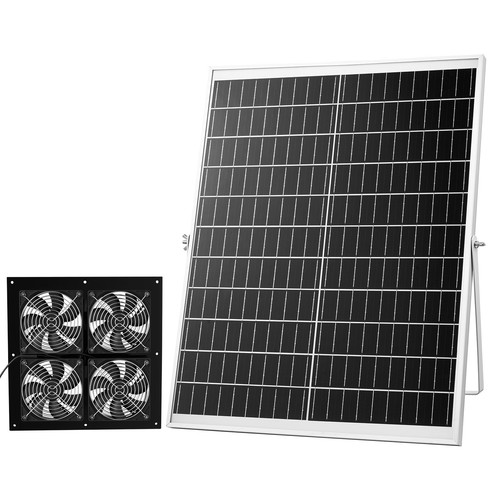
Pictured: VEVOR 25W fan
| Product | Condition | Price | Best For | Solar Panel Wattage | Number of Fans | Rated RPM (per fan) |
|---|---|---|---|---|---|---|
| VEVOR Solar Powered Fan 25W 4 Fans 2668 RPM for Greenhouse |
New | $$$ | Maximum airflow, larger spaces | 25W | 4 | 2668 |
 VEVOR Solar Powered Fan 15W 2 Fans 2668 RPM for Greenhouse VEVOR Solar Powered Fan 15W 2 Fans 2668 RPM for Greenhouse |
New | $ | Smaller spaces, tighter budgets | 15W | 2 | 2668 |
About the $ symbols: they’re a quick budget/mid/premium read of where each option sits relative to the others in this comparison. See current prices in the live listings below.
What most buying guides miss about off-grid solar fans
Most generic fan roundups gloss over the real-world trade-offs of running DC fans directly from solar panels. Here, every watt and every fan matters—more so than with plug-in or battery-powered units. The VEVOR 25W fan kit is the clear choice for anyone needing to move serious air in a greenhouse, shed, or small livestock shelter. With four 2668 RPM fans running off a 25W panel, you can ventilate a much larger area, or direct airflow to multiple hot spots.
The VEVOR 15W fan kit, on the other hand, is built for smaller spaces where you don’t need (or can’t fit) a larger panel or four separate fans. You get the same high RPM per fan, just half the total airflow, and a lower cost both up front and in mounting hardware. This is often the better match for tool sheds, small greenhouses under 8×8 feet, or even ventilating van or RV compartments during parked daylight hours.
Which solar powered fan is right for your setup?
If you need to keep temperatures down in a 12×12 foot greenhouse or larger, the VEVOR 25W fan is the obvious pick. The four-fan configuration spreads airflow more evenly, making a real difference in hot summer months. In contrast, the VEVOR 15W fan is ideal for compact spaces or where mounting options are limited—its smaller panel and dual fans are easier to install on a small roof or wall, and you’re not paying for more airflow than you’ll use.
Both systems are plug-and-play in the sense that the fans and panels are matched and designed to run together, but neither includes a battery for nighttime operation. These are sunlight-driven fans, best for daytime cooling and ventilation. If you need 24/7 airflow, a solar fan with battery backup or a full solar-plus-battery setup is a better fit (and a bigger investment).
How we shortlisted these solar fan kits
We focused on complete solar-powered fan systems designed for greenhouse and off-grid use, with clear manufacturer specs, matched solar panels, and at least two fans per kit. Key criteria included total wattage (minimum 15W for meaningful airflow), fan RPM (over 2500 for real cooling), and the ability to run directly from sunlight without extra parts. We compared the listed specs and positioning of each option against those benchmarks. Kits with unclear specs, single-fan models, or those requiring separate solar panel purchase were excluded to avoid confusion and mismatched performance.
This list is not for buyers who need whole-house cooling, overnight ventilation, or silent operation—these fans are purpose-built for daytime shed or greenhouse airflow, not for living rooms or bedrooms. If you need round-the-clock quiet airflow, consider a battery-backed DC fan or a grid-powered unit as a better fit.
For more on solar ventilation sizing and safety, the Solar Direct knowledgebase has practical guides and calculators.
Related Guides
- Solar Powered Fans That Are Actually Worth Buying
- Portable Solar Blankets That Are Actually Worth It
- Our guide to Solar Powered Phone Chargers That Really Work
- RV Power Converters Worth Buying
- Solar Generators vs Gas Generators: Which Is Best Off-Grid?
- How to Choose the Right Solar Charge Controller for Lithium Batteries
Specifications that actually matter
Solar Panel Wattage
This controls how much power the fan(s) can draw under full sunlight. For direct-solar fans, a panel rated under 10W often can’t keep up with heat buildup in midsize greenhouses. The VEVOR kits offer 15W and 25W panels, enough to run two or four high-speed fans, respectively—aim for at least 10W per 1-2 fans for real-world performance.
Number of Fans
More fans mean more airflow and better coverage, especially in long or partitioned spaces. Four fans let you ventilate multiple zones or both intake and exhaust sides of a greenhouse. For small sheds or single compartments, two fans may be sufficient—and easier to install in tight spots.
Fan RPM (Revolutions Per Minute)
Higher RPM generally means stronger airflow, assuming similar fan blade design and size. Both VEVOR kits list 2668 RPM per fan, which is at the high end for direct-solar models. If you see fans under 1500 RPM, expect much weaker airflow.
Direct Sunlight Operation
Neither kit includes a battery, so operation is tied to sunlight intensity. Expect best performance from late morning to mid-afternoon on clear days. If you need ventilation on cloudy days or after sunset, look for a solar fan with battery backup or plan to add a DC battery system.
Mounting Flexibility
The number and size of fans, plus the panel dimensions, affect where you can install the kit. Four-fan systems need more mounting spots and panel space; dual-fan kits are easier to fit on small roofs or walls. Always check your available installation area before choosing.
FAQ: Solar powered fans for greenhouses and sheds
How much area can these solar fans ventilate?
The VEVOR 25W fan, with four high-speed fans, can help ventilate greenhouses or outbuildings up to about 150-200 square feet, depending on insulation, vent placement, and sun exposure. The VEVOR 15W fan is better suited to spaces under 100 square feet. For larger areas, multiple kits or a higher-capacity system may be needed.
Will these fans run on cloudy days or at night?
Both VEVOR kits are designed for direct sunlight operation only. Output drops significantly in cloudy weather, and the fans do not run after sunset unless you add a separate battery and charge controller. For round-the-clock airflow, a solar fan with built-in battery or a plug-in model is required.
VEVOR 25W fan vs VEVOR 15W fan—which is better for a 10×12 greenhouse?
The VEVOR 25W fan is the stronger match for a 10×12 (120 square foot) greenhouse. Its four fans provide more even airflow and higher total ventilation, which is important for temperature control in midsize structures. The VEVOR 15W fan could work for smaller greenhouses or as a supplemental vent, but may not keep up on the hottest days in a larger space.
Are these solar fans noisy?
Both kits use high-RPM DC motors, which can produce noticeable noise, especially in enclosed spaces. While not excessively loud, they are not designed for silent operation. If noise is a concern, consider mounting the fans away from occupied areas or using acoustic baffles.
What if a fan or panel fails—are replacement parts available?
VEVOR typically offers replacement fans and panels for their systems, but availability can vary by region and distributor. Always confirm warranty terms and parts support with the seller before purchase. Consider keeping a spare fan on hand if downtime is critical for your setup.
Is the higher price of the VEVOR 25W fan justified over the 15W kit?
If you need to ventilate a larger area or want the ability to direct airflow to multiple zones, the higher price of the VEVOR 25W fan is justified by its greater capacity and versatility. For small sheds or tight budgets, the VEVOR 15W fan delivers good value with less installation complexity. Choose based on your actual space and cooling requirements.
Do these kits require professional installation?
No specialized electrical work is needed to set up either kit, as they are designed for basic DIY assembly: mount the panel, attach the fans, and connect the included wiring. However, always follow the manufacturer’s instructions and use proper safety gear for roof or ladder work. If you need to integrate the fans with existing electrical systems or batteries, consult a qualified installer.


Last updated: June 2026 · About our research