5 min read
Full-time off-gridders, weekend cabin owners, and RV travelers all face the same question: how can you get the most power from your solar panels, no matter where you’re parked or what season it is? The answer often comes down to optimizing the angle of your solar panels—tilting them just right can mean the difference between struggling to keep your batteries charged and having power to spare.
Why solar panel angle matters more than most people think
Solar panels generate electricity most efficiently when sunlight hits them directly—at a right angle. When your panels are flat or poorly angled, you lose a surprising amount of power, especially in winter or at higher latitudes. Even a small tilt adjustment can boost daily output by 10–30% or more. But the “best” angle depends on your latitude, the time of year, and whether your panels are fixed or adjustable. There’s no single answer that works for everyone, which is why understanding the principles behind panel tilt is so important.
Comparing common approaches to solar panel angle optimization
| Approach | How It Works | Typical Output Gain | Setup Complexity | Best For | Trade-offs |
|---|---|---|---|---|---|
| Fixed Flat Mount | Panels mounted flush to a surface, no tilt adjustment. | 0% (baseline) | Very low | Vans, RVs, stealth installs | Least efficient in winter; simple but less power year-round. |
| Fixed Tilt (set for latitude) | Panels permanently angled to match site’s latitude. | +10–20% vs. flat (annual avg.) | Low | Cabins, sheds, ground mounts | Not optimal in all seasons; better than flat in most cases. |
| Adjustable Seasonal Tilt | Manually adjust panel angle 2–4 times per year. | +20–30% vs. flat (annual avg.) | Moderate | Permanent off-grid, DIYers | Requires periodic adjustment; needs accessible mounting. |
| Single-Axis Tracker | Panel angle changes automatically to follow the sun’s arc. | +25–40% vs. flat (annual avg.) | High | Large ground arrays, high-budget setups | Complex, moving parts, higher maintenance. |
How to optimize solar panel angle: step-by-step
- Find your site’s latitude. Look up your location’s latitude using a GPS app or online map. This number, in degrees, is the starting point for most tilt calculations.
- Decide if you want to optimize for year-round, summer, or winter output. For maximum annual output, tilt panels equal to your latitude. For more winter power, add 10–15°; for summer, subtract 10–15°.
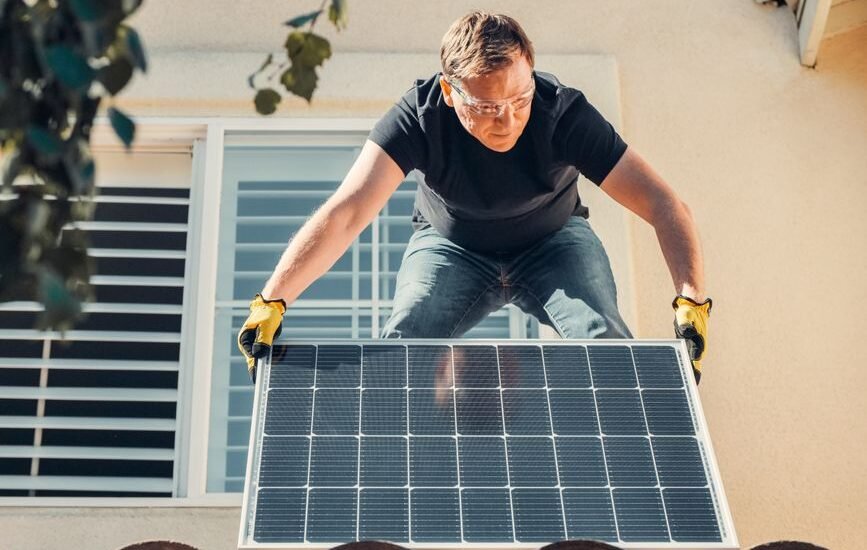
- Set or adjust the tilt angle. If your mount is adjustable, use a protractor, digital angle finder, or smartphone app to set the angle accurately. If fixed, install mounts at the chosen angle.
- Check for shading and obstructions. Make sure nothing (trees, vents, antennas) blocks sunlight at the chosen tilt—especially during key sun hours (9am–3pm).
- Re-adjust seasonally if possible. If your panels are on a ground mount or tilting rack, repeat steps 2–4 at the start of each season for best results.
Seasonal adjustment: is it worth the effort?
Adjusting your panel angle a few times a year pays off most if you live above 30° latitude or rely heavily on winter solar. In northern U.S. and Canada, tilting panels steeper in winter (latitude + 15°) helps catch low-angled sunlight and sheds snow. In summer, a flatter angle (latitude – 15°) maximizes midday power when the sun is higher. For many mobile users, frequent adjustment is impractical, but even a single winter/summer change can noticeably boost output.
Related Guides
- Folding Solar Panel Kits That Are Actually Worth Buying
- Why Does Solar Panel Voltage Drop When You Connect a Load?
- Choosing the Right Solar Panel Cable Connectors: What Matters Most
- How Do Solar Panel Bypass Diodes Work?
- Our guide to How to Choose the Right Solar Panel Tilt Mount for Your RV
- Our guide to How to Test Solar Panel Output: A Simple Step-by-Step Guide
- Browse all Solar Panels Kits →
A simple rule of thumb
For most fixed installations, set your panel tilt equal to your latitude for a good year-round average. In winter, tilt them steeper—about 15° more than your latitude. In summer, go 15° less. This rule gives you 80–90% of the benefit of more complex approaches, without needing to recalculate every month. It works best for stationary panels, but even RVers can use it when parked for more than a few days.
Why panel angle matters even more in winter
Shorter days, lower sun, and cloudier weather all hit solar output hard in winter. Panels mounted flat can see output drop by 50% or more compared to summer. Tilting panels up (sometimes nearly vertical in far north locations) helps catch those precious low-angle rays. It also helps snow slide off, which can otherwise block all output until you brush it away. If your batteries routinely struggle in winter, adjusting panel angle is almost always the lowest-cost way to gain extra watt-hours per day.
What about east-west vs. south-facing panels?
South-facing panels (in the northern hemisphere) deliver the highest total daily output, especially if you can adjust their tilt. East- or west-facing panels can help if you need power early or late in the day, but they’ll produce less overall—typically 10–25% less than south-facing at the same tilt. In some off-grid setups, mixing a few east- or west-facing panels with mostly south-facing ones helps spread out power delivery for morning or evening loads. But for pure efficiency, aim for south and adjust the tilt.
FAQs about optimizing solar panel angle
How much difference does tilt really make?
Tilting panels can boost output by 10–40%, depending on your latitude and the season. The effect is biggest in winter and at higher latitudes. In sunny southern locations, the gain is smaller but still noticeable.
Can I just leave my panels flat?
Flat panels will work, but you’ll lose efficiency—especially in winter, when you may get only 60–70% of what tilted panels could generate. For RVs and vans, flat is often a necessary compromise for stealth and aerodynamics.
Do adjustable mounts pay off?
If you’re stationary or semi-stationary and can access your panels safely, adjustable mounts are worth it. The increased output often justifies the extra effort, especially for small or marginal systems.
Is there a “perfect” angle for every day?
Yes, but it changes daily as the sun’s position shifts. In practice, most people use seasonal or monthly adjustments, which capture most of the benefit without constant tinkering. Automated trackers can follow the sun more closely, but they add cost and complexity.
How do I measure the tilt angle accurately?
You can use a digital angle finder, a simple protractor, or even a smartphone app that measures angle. Place the tool against the panel frame, not the roof or ground, for an accurate reading.
What if my roof faces the wrong way?
Panels facing east or west will still work, but with lower total output. If possible, add more panels to compensate, or use portable/ground mounts that can be aimed more directly at the sun.
More resources for optimizing solar setups
For detailed solar angle calculators and region-specific charts, see resources from the National Renewable Energy Laboratory. For hands-on advice on mounting options and seasonal adjustment, off-grid forums and DIY solar communities often share real-world tips and photos that go beyond theory.
Last updated: July 2026 · How we cover this topic