7 min read
Disclosure: As an Amazon Associate and eBay Partner Network publisher, we earn from qualifying purchases. This doesn’t affect what we recommend or how we describe it.
How much cooling can a small 12V air conditioner really provide when you’re running off solar, batteries, or a modest generator? And will it actually work in a van, RV, or off-grid cabin without draining your power bank by lunchtime? These are the questions nearly every off-grid builder wrestles with once summer hits. The truth: most “12V” air conditioners are either wildly underpowered fans, or they draw so much current they’re useless unless you have a monster battery bank. But a handful of real solutions do exist—if you know what to look for, how to size your setup, and which trade-offs you’re willing to make.
Small 12V air conditioners that actually work off the grid: side-by-side comparison
| Configuration | Cooling Output (BTU/h) | Power Draw (Watts) | Continuous Runtime (on 100Ah LiFePO4) | Noise Level (dB) | Price |
|---|---|---|---|---|---|
| Compact 12V DC Split System | 3,000 | 300–480 | 2–3 hrs | 45–55 | $$$ |
| Portable 12V Compressor Unit | 1,300 | 120–240 | 4–7 hrs | 50–60 | $$ |
| Thermoelectric Cooler/Fan Hybrid | 400 | 35–65 | 12–24 hrs | 35–45 | $ |
| 12V Evaporative Swamp Cooler | — | 15–40 | 24+ hrs | 40–50 | $ |
What most buying guides get wrong about small 12V air conditioners
Most “12V air conditioners” you’ll find online are either fans, swamp coolers (evaporative), or thermoelectric coolers—none of which truly cool the air like a real compressor-based AC. Many guides lump these together, making it hard to know what you’re actually buying. If you want genuine air conditioning—meaning it can drop the temperature in a closed space by at least 10°F—skip the thermoelectric and evaporative models unless you live in a dry climate or only need a small temperature drop. Compressor-based units (mini-split or portable) are the only way to get real cooling, but they require careful sizing and power planning.
How to size a small 12V air conditioner for your off-grid setup
The most common mistake: underestimating both the cooling load and the power draw. A van or small RV usually needs at least 2,000–3,000 BTU/h to feel a real difference on a hot day. For a 12V system, this means a continuous draw of 250–500W. That’s 20–40A at 12V—enough to drain a standard 100Ah LiFePO4 battery in 2–4 hours. If your battery bank is smaller, or your solar can’t keep up, you’ll be disappointed. Always add up your total amp-hour capacity, subtract what you need for lights and other essentials, and see what’s left for cooling. Most off-grid setups below 200Ah of usable battery simply can’t run a compressor AC for long without a generator or shore power backup.
Why “12V” doesn’t always mean off-grid friendly
Watch out for units marketed as “12V” but designed for engine alternator use, not continuous battery operation. Some “RV” ACs expect a running vehicle to supply 13.5–14V and can trip off if your battery voltage sags. Others have startup surges that far exceed their rated running amps. Always check the minimum and maximum input voltage, and look for soft-start or inverter-compressor designs that are gentler on batteries.
Related Guides
- Our guide to Small 12V Air Conditioners That Actually Work Off the Grid
- Small 12V Freezers for Off-Grid Living
- Solar Combiner Boxes That Actually Work: What’s Worth Buying
- 12V Ceiling Fans That Are Actually Worth Buying
- 12V Portable Heaters for Off-Grid Comfort: What’s Worth Buying?
- Our guide to All-in-One Inverter Chargers That Are Actually Worth Buying
Quick decision tree
- If runtime on a small battery is your top priority: Go with a thermoelectric hybrid or evaporative cooler (expect modest cooling, but 12–24+ hours on 100Ah battery).
- If you need true air conditioning in a van or micro-cabin: Only a compact 12V DC split system or portable compressor unit will deliver—plan for 2–7 hours max runtime on 100Ah, and size your batteries up if you want more.
- If you live in a dry climate (low humidity): A 12V swamp cooler can feel surprisingly effective and sip power, but won’t help in muggy conditions.
- If quiet operation matters (stealth camping, night use): Thermoelectric or split systems are quieter than portables; check for 35–50 dB specs.
- If budget is your main constraint: Evaporative and thermoelectric options are cheapest up front, but deliver the least cooling.
The spec almost nobody talks about: battery bank compatibility
Battery chemistry matters. LiFePO4 batteries can deliver high current safely and repeatedly, making them much better for running compressor ACs than standard lead-acid or AGM batteries, which sag in voltage and lose usable capacity rapidly under heavy loads. If you’re running a 12V compressor unit, aim for at least 200Ah of LiFePO4 for a few hours’ runtime, or double that if you want to make it through a hot night. For thermoelectric or evaporative units, 100Ah is plenty for all-night use.
Real-world pros and cons of each 12V AC approach
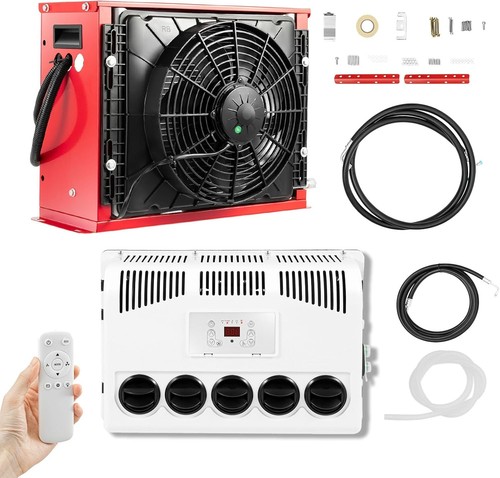
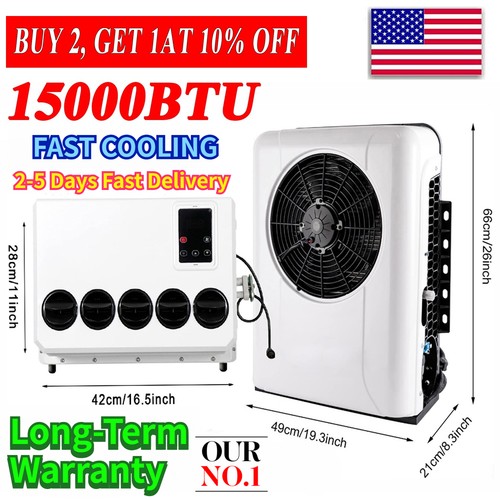
- Compact 12V DC Split Systems: Most efficient and effective, but require permanent installation and the highest up-front cost. They need a robust battery and solar setup, and installation means cutting a hole for the evaporator. Excellent for full-time vanlifers and tiny homes.
- Portable 12V Compressor Units: Easier to install, can move between vehicles/rooms, and offer decent cooling for small spaces. Still power-hungry, but manageable with a decent battery bank. Some have built-in soft-start to help with startup surges.
- Thermoelectric Cooler/Fan Hybrids: Ultra-low power draw, very quiet, and lightweight. Only drops temps by a few degrees—best for spot cooling or sleeping areas, not whole-room use. No moving parts means longer lifespan.
- 12V Evaporative Swamp Coolers: Cheapest and most energy-efficient, but only work well in dry, low-humidity climates. In humid areas, they just make things clammy. They need regular water topping-up.
How to match your air conditioner to your solar and battery setup
Calculate your daily amp-hour budget. For example, a 300W split system running 3 hours needs 75Ah at 12V. Add 30% margin for inverter losses and inefficiencies. Your solar array should replace at least as much as you use each day—so for 75Ah consumption, you’ll want a minimum 300–400W of solar in summer (more if you use AC longer or have cloudy days). A power station with a 1000W inverter and 1200Wh LiFePO4 battery can run a portable compressor AC for 3–4 hours max. For longer runtime, you need more battery or a generator backup. View what’s available.
FAQ: Small 12V air conditioners for off-grid use
How many amps does a small 12V air conditioner actually draw?
Compressor-based 12V units typically draw between 10 and 40 amps, depending on size and cooling load. Thermoelectric and evaporative models draw much less—usually under 5 amps continuous. Always check the rated and surge (startup) current before buying.
Will a 100Ah battery run a 12V air conditioner all night?
No, not if it’s a real compressor-based AC. A 300W unit will drain a 100Ah battery in about 3 hours. Only thermoelectric or evaporative units can run 8–12 hours on 100Ah, and they won’t cool nearly as much. To run a compressor AC all night, you’d need at least 300–400Ah of usable battery.
Compressor AC vs evaporative cooler—which is better for vans?
Compressor ACs provide true cooling regardless of humidity, but use much more power and require a bigger battery bank. Evaporative coolers are only effective in dry climates and don’t work well in muggy areas. For most van dwellers, a compressor AC is better if you can afford the battery and solar investment.
What’s the minimum solar panel size to run a small 12V AC?
For a 300W compressor AC running 3 hours per day, you’ll need at least 300–400W of solar panels in full sun just to break even. For longer use or cloudy weather, aim for 500–600W or more. Always oversize your array to cover cloudy days and other loads. Compare options.
Are there any warranty or return issues with off-grid air conditioners?
Many 12V AC units marketed for vehicles or off-grid use have limited warranties, often 1 year or less. Some require professional installation for warranty coverage. Always check return policies—some sellers charge hefty restocking fees for opened units. Save your receipts and test the unit thoroughly as soon as it arrives.
How loud are these small 12V air conditioners in real use?
Compressor-based split and portable units usually produce 45–60 dB—about as loud as a quiet conversation. Thermoelectric and swamp coolers are quieter, around 35–50 dB. For stealth camping or sleeping, check the decibel rating before buying. See today’s deals.
Where to go for deeper technical specs and research
For detailed technical standards and independent testing on small air conditioners, including off-grid applications, see the Air-Conditioning, Heating, and Refrigeration Institute, which sets performance benchmarks for HVAC equipment. For off-grid power system planning, the National Renewable Energy Laboratory offers practical guides and calculators for sizing batteries and solar to match your needs.


Last updated: July 2026 · How we cover this topic