7 min read
Disclosure: As an Amazon Associate and eBay Partner Network publisher, we earn from qualifying purchases. This doesn’t affect what we recommend or how we describe it.
Can you actually trust a lithium iron phosphate (LiFePO4) battery to power your off-grid cabin or van year after year, or is a tried-and-true AGM the safer bet? Here’s the practical truth: your choice determines not just how long your batteries last, but how much you’ll spend up front, how much space you’ll need, and how much you’ll be able to run at once. Below, you’ll find what really matters for off-grid setups—no jargon, just clear pros, cons, and real numbers—so you can choose the right battery type for your needs, not just the latest hype.
Spot the difference between LiFePO4 and AGM battery setups
| Option Type | Usable Capacity (100Ah unit) | Cycle Life | Weight | Maintenance | Price |
|---|---|---|---|---|---|
| Entry-level AGM | 50Ah (50% DoD) | 300–500 cycles | 29 kg | None | $ |
| Premium AGM | 60Ah (60% DoD) | 700–900 cycles | 32 kg | None | $$ |
| Standard LiFePO4 | 90Ah (90% DoD) | 2500–3500 cycles | 12 kg | None | $$$ |
| High-performance LiFePO4 | 95Ah (95% DoD) | 4000+ cycles | 11 kg | None | $$$ |
Price tiers ($/$$/$$$) read across this comparison only — they mark each product’s relative position from cheapest to priciest in the set. Actual prices live below.
Choose the right battery for your off-grid setup
Picking between AGM and LiFePO4 isn’t just about chemistry—it’s about matching your battery to your actual daily use, charging sources, and how long you want the system to last. Here’s what you need to consider to avoid expensive mistakes:
- Budget and up-front cost: AGM batteries cost much less up front, but you’ll replace them far more often. LiFePO4 costs more initially, but delivers a lower cost per cycle and longer lifespan.
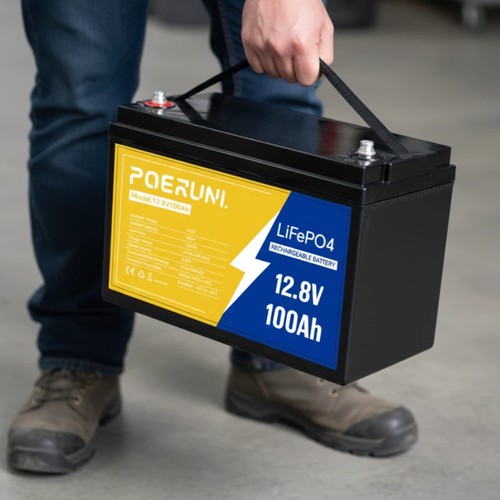
- Weight and space constraints: Lithium iron phosphate batteries weigh about 60% less than comparable AGM units. In a van or small RV, this is a game-changer. For stationary cabins with a big battery bay, the weight savings may matter less.
- Usable capacity: You can only safely use about 50% of an AGM battery’s rated capacity without shortening its life (so a “100Ah” AGM is really just 50Ah of usable energy). LiFePO4 batteries safely provide 90–95% of their rated capacity. That means you need fewer amp-hours of lithium for the same usable power.
- Cycle life and long-term value: Expect 300–900 cycles from most AGMs (one cycle per day = 1–2.5 years). LiFePO4 batteries routinely deliver 2500–4000+ cycles (7–11 years of daily use). That’s why lithium is king for full-timers and those who hate replacing batteries.
- Charging speed and solar compatibility: LiFePO4 accepts higher charge rates (up to 0.5C–1C, or 50–100A for a 100Ah battery), letting you top off much faster with a strong solar array or generator. AGMs must be charged slower to avoid damage, often at just 0.2C (20A for a 100Ah battery).
- Temperature sensitivity: AGM performs better in freezing temps and can be charged below 0°C, though with reduced efficiency. Most LiFePO4 batteries cannot be charged below 0°C unless they have built-in heaters; discharging is usually fine down to -20°C. Factor this in if you’re in a cold climate.
Quick decision tree
- If you want the lowest up-front cost: Entry-level AGM is the way to go, but expect to replace more often.
- If you need maximum usable energy per kg: High-performance LiFePO4 is unbeatable for vanlifers and weight-sensitive builds.
- If you camp or live in regularly freezing conditions: AGM handles cold charging better out of the box.
- If you want to “set and forget” your battery bank for 7–10 years: Standard or high-performance LiFePO4 delivers the best long-term value.
- If fast solar or generator charging is a must: Lithium iron phosphate handles higher charge rates safely.
Real-world sizing: how much battery do you actually need?
Don’t size your battery bank by just adding up the numbers in the table. The real trick is calculating your daily energy use and matching it to your battery’s usable capacity. Here’s a simple way to do it:
- Add up your daily amp-hour (Ah) needs. For example, running a 12V fridge (40Ah), LED lights (10Ah), and charging devices (15Ah) totals 65Ah/day.
- For AGM, divide your daily Ah needs by 0.5 (since you can only use 50%). Example: 65Ah / 0.5 = 130Ah battery needed.
- For LiFePO4, divide by 0.9 (since you can use 90%). Example: 65Ah / 0.9 ≈ 72Ah battery needed.
This means a single 100Ah LiFePO4 easily covers your needs, while you’d need at least two 100Ah AGMs for the same usable energy—doubling the weight and space.
Check current pricesKnow the practical pros and cons for daily off-grid use
Plenty of guides will tell you about “deep cycle” and “sealed construction,” but here’s what actually matters in the field:
- AGM batteries: Reliable, widely available, and great for cold climates. They’re heavy, slow to charge, and wear out quickly if cycled deeply every day. You’ll need more space and more frequent replacements.
- LiFePO4 batteries: Lightweight, compact, and happy with daily deep cycles for years. They cost more up front, require a battery management system (BMS) for safety, and need protection from freezing temperatures when charging. Almost zero maintenance and much faster recharge times.
Still not sure which fits your setup? Let’s tackle the most common questions people ask when deciding between lithium iron phosphate and AGM batteries.
Related Guides
- Our guide to Lithium Iron Phosphate vs AGM Batteries: Which Is Right for Off-Grid Power?
- Lithium Batteries for RVs, Reviewed
- How to Choose the Right Solar Charge Controller for Lithium Batteries
- How to Store Lithium Batteries Long Term: Tips for Maximum Lifespan
- Our guide to How to Winterize Lithium Batteries: A Step-by-Step Guide
- Lithium vs AGM Batteries: Which Should You Choose for Off-Grid Power?
FAQ: lithium iron phosphate vs agm batteries for off-grid power
How long does a lithium iron phosphate battery actually last?
Most LiFePO4 batteries deliver 2500–4000 cycles at 80–90% depth of discharge. That translates to 7–11 years of daily cycling before capacity drops below 80%. Compare that to 1–2.5 years for typical AGMs under the same use.
Is AGM or LiFePO4 better for a van or RV with limited space?
LiFePO4 is the clear winner for space- and weight-constrained builds. For the same usable energy, lithium batteries weigh about one-third as much and take up 30–40% less space than AGMs. This makes a huge difference in vans, small trailers, and campers.
Can I mix AGM and LiFePO4 batteries in the same system?
No—you should never mix different battery chemistries in the same bank. They have incompatible voltage profiles, charging requirements, and discharge characteristics. Mixing them can cause overcharging, undercharging, or even damage to both types.
What happens if I charge a LiFePO4 battery below freezing?
Charging most LiFePO4 batteries below 0°C (32°F) can permanently damage the cells. Some advanced models include internal heaters or BMS logic to prevent charging in cold conditions. Always check the spec sheet—if winter charging is essential, AGM may be safer without added complexity. For a technical deep dive, see International Electrotechnical Commission standards on battery safety.
Are lithium iron phosphate batteries safe?
Yes, LiFePO4 is one of the safest lithium chemistries available. They’re far less prone to thermal runaway or fire than lithium cobalt-based batteries. Still, only use LiFePO4 batteries with a built-in BMS (battery management system) to protect against overcharging, over-discharging, and temperature extremes. For more on battery safety, see Underwriters Laboratories.
What warranty should I expect for AGM vs LiFePO4?
Most AGM batteries come with a 1–2 year warranty. LiFePO4 batteries often include 5–10 year warranties, reflecting their longer expected lifespan. Always check the fine print for cycle limits or capacity guarantees—some “long” warranties require proof of proper use or limit coverage to a certain number of cycles.
Which is more forgiving if I forget to recharge for a few days?
LiFePO4 batteries tolerate a partial state of charge and occasional deep discharge much better than AGMs. Lead-acid batteries (AGM included) suffer permanent capacity loss if left partially discharged for long periods. Lithium’s resilience is a big plus for intermittent solar or inconsistent charging sources.
See today’s dealsFinal word: which battery type actually fits your real-world needs?
For most off-grid homeowners, RVers, and vanlifers who want a long-lasting, lightweight, and “set it and forget it” battery, lithium iron phosphate is the best value over the long haul—even if the sticker price stings. AGM can still make sense if you’re on a tight budget, need to charge in freezing weather, or want a reliable backup bank for occasional use. The best battery is the one that fits your budget, your space, and your actual power needs—not just the latest trend.
Ready to build your system? View what’s available and compare specs before you buy.


Last updated: June 2026 · How we cover this topic