7 min read
Getting the tilt angle of your solar panels right is one of the easiest ways to boost your off-grid system’s daily output—without spending a dime extra on more panels. Whether you’re mounting panels on a cabin roof, building a ground rack, or using portable folding panels for your RV or van, the angle you choose directly affects how much sunlight your system can capture during every month of the year. But there’s no one-size-fits-all answer: the “best” tilt angle depends on your latitude, your seasonal energy needs, your mounting method, and how much effort you’re willing to put into adjusting the setup. Here’s how to make the smartest tilt angle choice for your off-grid solar array, with real-world examples and honest pros and cons for each approach. For more detail, see Wikipedia: Solar panel.
Comparison: Fixed vs. Adjustable Solar Panel Tilt Setups
| Configuration | Typical Tilt Range | Seasonal Adjustability | Ease of Installation | Performance Gain |
|---|---|---|---|---|
| Fixed Roof-Mount (Flush) | 0–15° | None | Very Easy | Lowest (up to 25% annual loss) |
| Fixed Rack-Mount (Set Angle) | 15–45° | None | Easy–Moderate | Better (5–15% loss vs. optimal) |
| Manual Adjustable Rack | 15–65° | Manual, 2–4x/year | Moderate | Highest (up to 25% annual gain) |
| Portable Tilting Panels | 0–60° | Manual, easy | Very Easy | High (seasonal gain) |
Latitude and the Ideal Solar Panel Tilt Angle
Your latitude is the single most important factor for setting a fixed tilt angle. For most off-grid users in the continental US, Canada, and Europe, latitude ranges from about 25° (South Florida) to 55° (northern Canada or Scotland). The rule of thumb: set your fixed tilt angle equal to your latitude for decent year-round performance. For example, if you’re at 40° latitude (Denver, Madrid, or Beijing), a 40° tilt will maximize your annual solar harvest.
- Below 30° latitude: 20–30° tilt works well.
- 30–50° latitude: Match tilt to latitude (30–50°).
- Above 50° latitude: Consider 50–60° tilt, especially for winter use.
Using a tilt angle much flatter than your latitude (such as mounting flush on a shallow roof) can reduce winter production by 20–30%—a major issue for off-grid cabins or homes with high winter usage.
Seasonal Tilt Adjustments: How Much Difference Does It Make?
If you can manually adjust your panel tilt 2–4 times per year, you can squeeze out 10–25% more energy compared to a fixed angle. Here are the common seasonal settings:
- Winter: Tilt = latitude + 15° (steeper angle catches lower sun and sheds snow).
- Spring/Fall: Tilt = latitude.
- Summer: Tilt = latitude – 15° (flatter angle for higher sun).
For example, at 40° latitude, you’d use 55° in winter, 40° in spring/fall, and 25° in summer. This approach is most practical with ground racks or tilt-legs, not with flush roof-mounts.
Choosing the Right Tilt Setup for Your Off-Grid Needs
Your mounting method and how you use your system should drive your tilt angle decision:
- Cabin or Homestead (Year-Round Use): If you’re living off-grid all year, a fixed tilt set to your latitude is the best compromise. If you rely heavily on solar in winter, consider a steeper angle or an adjustable rack.
- RV or Van (Mobile Use): Most RV/van roofs are flat, so panels are usually flush-mounted (0–5° tilt). This is simple but loses winter output, especially above 35° latitude. Portable tilting panels or tilt-legs can help if you camp in one spot for several days.
- Seasonal Cabin (Mostly Summer Use): Set a flatter tilt (latitude – 10–15°) to maximize summer output, since winter production won’t matter.
- Portable Systems: Folding panels with adjustable tilt legs let you aim panels more accurately, but require setup effort and vigilance against wind gusts.
See today’s deals
How Roof Pitch Limits Solar Panel Tilt
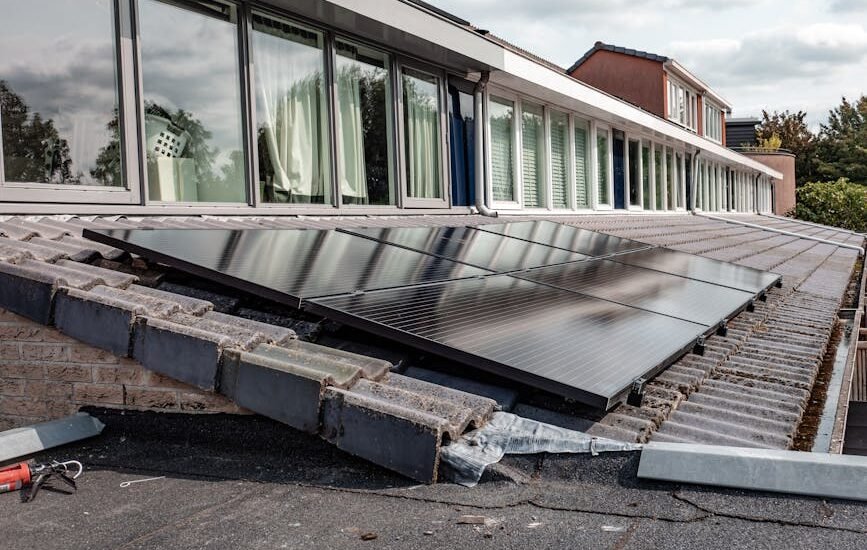
If you’re mounting panels on a roof, your tilt is often limited by the roof pitch. For example, a 4/12 pitch roof has a slope of about 18°. Mounting panels flush is simplest, but this may be far from optimal for your latitude—especially for steep winter sun angles. Tilt brackets can help, but most roof-mounts are designed for flush installations due to wind and code compliance. On flat roofs, you can use tilt legs to achieve nearly any angle, but watch for wind loading and shading from adjacent panels.
Snow Shedding and Maintenance: Why Steeper Angles Matter
Panels tilted 30° or more shed snow and debris much better than flat or low-tilt panels. If you depend on solar through snowy winters, a steeper tilt (latitude + 10–15°) can keep your panels cleaner and reduce the need for manual clearing. This is especially important for off-grid cabins where you can’t always be on-site after a storm.
Wind Loading and Structural Safety Limits
The steeper the tilt, the greater the wind load on your mounting hardware. Adjustable racks and tilt-legs must be securely anchored, especially in exposed locations. In high-wind areas, a flush mount or low tilt may be safer, even if it sacrifices some output. Always follow the mounting hardware’s rated wind load specifications—never exceed them for the sake of a few extra watts.
View what’s available
Related Guides
- How to Tilt Solar Panels for Maximum Sunlight: A Practical Guide
- The Best Motorized Solar Panel Tilt Mounts for Easy Solar Tracking
- Solar Generators vs Gas Generators: Which Is Better for Off-Grid Power?
- Solar Powered Phone Chargers That Actually Work: A Practical Buyer’s Guide
- How to Use a Solar Charge Controller: Step-by-Step Instructions
- A No-Nonsense Guide to Solar Panel Mounting Brackets That Last
- Browse all Solar Panels Kits →
- The Best Portable Solar Panels for Camping, Reviewed
FAQ: What’s the “Best” Tilt Angle for My Location?
For fixed panels, set your tilt equal to your latitude for year-round use. Adjust steeper (+10–15°) for winter-only setups, or flatter (–10–15°) for summer-only use. For example, at 36° latitude: use 36° tilt for annual use, 50° for winter, or 25° for summer.
FAQ: Is It Worth the Effort to Adjust My Tilt Seasonally?
If you can change the tilt 2–4 times per year, you’ll typically gain 10–25% more solar energy compared to a fixed angle—especially valuable for off-grid systems struggling to meet winter demand. The extra effort is most worthwhile for ground-mounted arrays or when you’re on-site to make the adjustment.
FAQ: What About Tilting Panels on My RV or Van Roof?
Most RV and van panels are mounted flat for simplicity and to avoid wind damage while driving. This is fine for summer travel, but in winter or at high latitudes, output drops sharply. If you stay parked for days, consider a portable folding panel with tilt legs, or install mechanical tilt brackets if your roof design allows.
FAQ: Does East/West Tilt Matter or Just the Up/Down Angle?
Both matter, but the up/down (tilt) angle has a bigger impact. For maximum output, aim panels due south (in the northern hemisphere) or due north (in the southern hemisphere). Deviating more than 30° east or west can reduce output by 10–20%. For mobile setups, just getting the tilt angle right is usually a bigger win than worrying about perfect compass alignment.
FAQ: How Do I Calculate My Latitude?
You can look up your location’s latitude using any mapping app or online tool—just search for your town or GPS coordinates. The number you want is the degrees north (or south) of the equator. For example, Austin, Texas is about 30°N; Toronto is 43°N; London is 51°N.
FAQ: Will I Void My Warranty by Adding Tilt Brackets?
If you use mounting hardware rated for your panel’s size and wind conditions, and follow the manufacturer’s instructions, you won’t void warranties. Avoid homemade mounts or modifications that could overstress the panel frame or glass. Always check your panel and mounting hardware documentation for any restrictions on tilt or mounting orientation.
FAQ: How Much Power Will I Lose with a Flat Mount?
At 40° latitude, a flat mount can lose 15–25% of annual output compared to a panel tilted to 40°. The loss is much greater in winter—sometimes over 40%—and less in summer. If your system is undersized or you rely on winter solar, this can be a dealbreaker.
Summary: Make the Most of Your Solar Array with Smart Tilt Choices
Dialing in the right tilt angle for your solar panels is one of the most cost-effective upgrades you can make to any off-grid power system. Match your panel tilt to your latitude for the best year-round results, or tweak it seasonally if you need every watt. Consider the practical limits of your mounting method, roof pitch, and how you use your system. And don’t forget: sometimes the simplest setup—like a fixed tilt close to your latitude—is the best balance of performance, safety, and maintenance.on adjustable racks, tilt legs, and portable panel kits to see what fits your budget and setup best.
Last updated: May 2026 · How we cover this topic